In Decor Tips
Large Furniture in Small Spaces: Why Bigger Can Work
Some links in this post are Amazon affiliate links, which means we may earn a small commission at no extra cost to you.
There is a strange little rule we seem to follow when decorating a small room: everything must be small. Small sofa. Small rug. Small artwork. Tiny little side table that can technically hold a mug if you balance it carefully and don't breathe too hard.
The logic seems sound. If the room is short on space, surely the furniture should be short on ambition too. Except…not always.
One of the most useful decorating lessons I've come across lately is about scale—and more specifically, the idea that a small room doesn't necessarily need small furniture.
Interior designer Emma Beryl Kemper recommends varying the height and scale of things throughout a room so that the eye naturally moves around the space. She compares an interesting room to a skyline: if every building were exactly the same height, there wouldn't be much to look at.
Ashley Montgomery makes a similar point when talking about lighting, arguing that we shouldn't automatically assume small rooms need tiny fixtures. Sometimes, she says, a slightly-too-large piece is exactly what gives a room some personality. And honestly? I think this applies to much more than chandeliers.
Your Small Room Doesn't Need a Dollhouse Version of Everything
Think about a small living room filled with small things. A petite sofa. Two little chairs. A tiny coffee table. Several small frames on the wall. A little rug that sits politely underneath the coffee table but doesn't quite reach the sofa. Technically, none of these things should overwhelm the room.
But put them all together and suddenly the room can feel strangely… crowded. Not physically crowded, necessarily. Visually crowded. That's the part we forget.
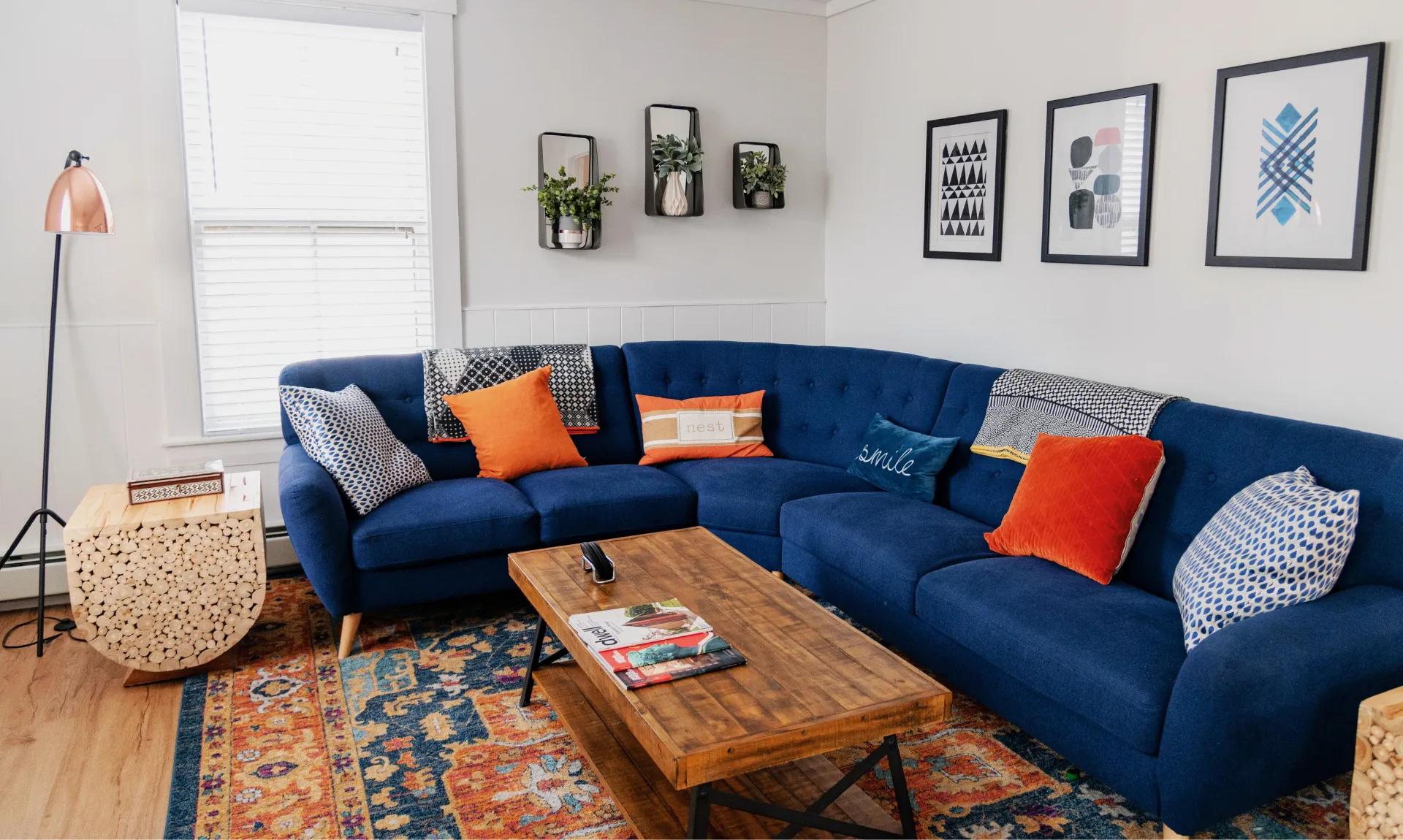
Sometimes one substantial piece gives everything else somewhere to settle. A larger rug can pull your seating area together instead of creating a little island in the middle of the floor. A generous piece of artwork can give a small wall more presence than a cluster of tiny frames. A properly scaled sofa can actually look calmer than squeezing several miniature seats into the same footprint.
The trick isn't to make everything enormous. It's to stop assuming that smaller automatically means better.
Think Like a Skyline
This is the part of Kemper's advice I particularly like. A skyline has rhythm because the buildings don't all stop at the same height. There's the skyscraper, the low building, something in between, and perhaps one odd structure that makes you wonder who approved the architecture. Your room needs some of that rhythm too.
Try looking around your space and notice whether everything is sitting at roughly the same visual level. Maybe your coffee table has three objects that are all approximately the height of a coffee mug. Your bookshelf has six decorative pieces lined up like they're waiting for a school photograph. Your bedroom has a small lamp, small artwork and small bedside accessories all quietly competing for attention.
Nothing is wrong with any individual piece. It's the sameness that's making things fall flat. Add something tall. Then something low. Put a substantial object beside something delicate. Let one piece be a little dramatic while the others take a supporting role.
Suddenly, your eye has somewhere to travel. And isn't that what good rooms do? I have shared a detailed guideline on how to design your bedroom like a pro, which will help you a lot in understanding what might work best for your space!
This Works Outside the Living Room Too
You can use the same idea almost anywhere. In an entryway, try a larger mirror above a narrow console instead of filling the wall with lots of little decorations. In a bedroom, an oversized piece of art or a more substantial headboard can give the bed wall a sense of importance without requiring ten decorative objects to make up for its absence.
In the kitchen, one large cutting board leaning against the backsplash can sometimes look more intentional than a collection of five tiny decorative pieces. And on a bookshelf, please don't make every object stand at attention. Let the books create height. Stack some horizontally. Add one taller vase or framed photograph. Leave a little breathing room. Your shelves aren't a military parade.
Bigger Isn't the Point. Contrast Is.
This doesn't mean you should rush out and buy the largest sofa you can find because an interior designer on the internet told you to embrace scale. Please measure first. Your doorway would appreciate it. The real lesson is contrast.
If everything in your room is tiny, nothing feels particularly important. If everything is oversized, well, congratulations, you've created a room where the furniture is apparently having a meeting without you. But one or two pieces with a little more visual weight can make the smaller things around them feel intentional.
It's a bit like writing. If every sentence is short, the rhythm eventually becomes predictable. You need longer sentences, pauses, the occasional dash—something that makes your eye slow down. A room works much the same way.
Not everything needs to shout. But something needs to have a voice.
So the next time you're decorating a small room, don't automatically reach for the smallest version of everything. Ask yourself a better question:
What does this room need to make the eye move?
Maybe it's a larger rug. Maybe it's one piece of art that takes up half the wall. Maybe it's a tall plant beside a low sofa or a generously sized mirror in a narrow hallway. Your home may be small. Your decorating ideas don't have to be.
Budget Space Picks
- DUMOS 43 Inch Folding Storage Ottoman BenchThis storage ottoman gives you a comfy spot to sit at the foot of the bed while hiding blankets, pillows, and other bedroom clutter inside. At around $30, it’s one of those rare decor upgrades that looks good and actually solves a problem.View on Amazon
- MAXYOYO Modern Accent Chair For Comfy Living With Metal FrameA soft, minimalist accent chair with tufted corded fabric, supportive cushioning, and sturdy wooden armrests. Perfect for adding a comfortable, stylish seat to your living room, bedroom, or office.View on Amazon
- Rattan Boho Floor Lamp with Remote ControlElevate your space with this adjustable arc floor lamp featuring stepless dimming, three color temperatures, and interchangeable rattan and linen shades.View on Amazon
A Little Room for Something Unexpected
Maybe that's the real trick with decorating a small space: don't spend all your energy trying to make everything disappear.
Choose the pieces that matter, give them room to shine, and let your home have a little personality along the way. Because the best rooms aren't necessarily the ones that follow every rule, they're the ones that feel like someone actually lives there.
Want more practical decor ideas that don't require a huge budget or a huge house? Keep exploring My Budget Space for more ways to make your home feel like home.
Continue Reading
Best Apartment Lighting Ideas to Brighten Your Space on a Budget
Best Storage Solutions for Small Spaces That Don't Sacrifice Style
FAQs
Can you use large furniture in a small room?
Yes. A small room doesn't automatically mean every piece of furniture needs to be small. The important thing is how the piece fits the room and how much else you place around it.
What is scale in interior design?
Scale is the relationship between the size of furniture or decor and the room itself, as well as the other objects around it. Varying scale can help create visual interest and keep a room from feeling too uniform.
Does oversized furniture make a small room look smaller?
Not necessarily. One larger, well-chosen piece can sometimes make a room feel more intentional than several undersized pieces. The overall arrangement and amount of visual clutter matter just as much as the size of an individual item.
How do you make a small room look stylish?
Focus on a few pieces you genuinely like rather than trying to fill every empty corner. Mixing different heights, sizes, textures, and shapes can give the room character without requiring lots of decor.
Should small rooms have small rugs?
Not always. A rug that is too small can visually separate furniture and make a seating area feel disconnected. Choosing the largest rug that works comfortably within the space can help create a more unified look.